The SPHERE ZIMPOL data reduction flow (imaging).
The overall data flow of the SPHERE pipeline for ZIMPOL data is displayed here for the imaging mode (see next section for polarimetry).
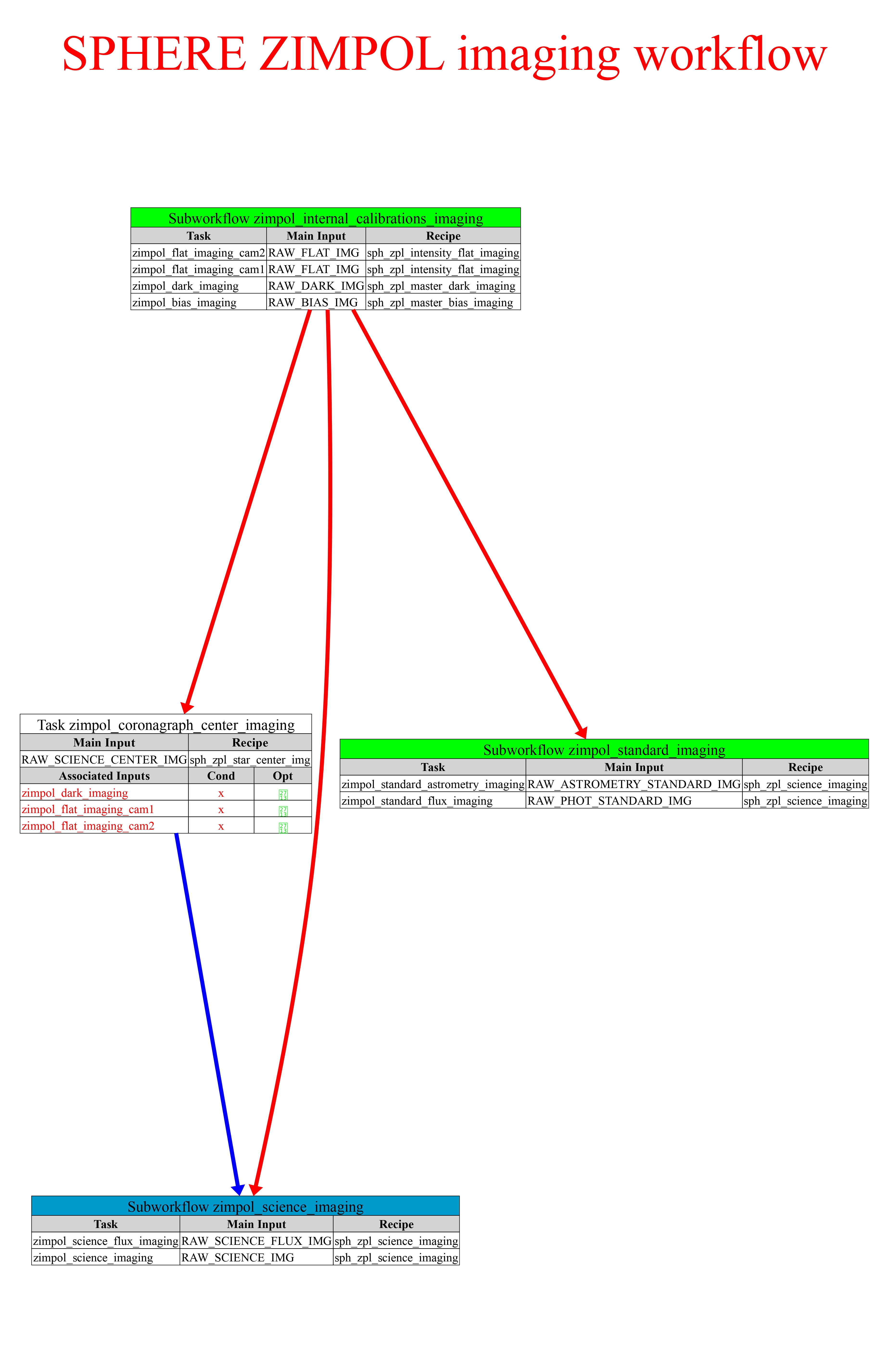
The reduction cascade is organized in tasks, which represent well-defined steps in the process. Tasks can be grouped inside sub-workflows. Each task runs a recipe; the detailed description of the algorithms, input, outputs and recipe parameters used in each recipe are available in the pipeline manual. Here, we present only the description of most important features.
The EDPS workflow is designed to execute the tasks that deliver the final reduced data cube for each dataset. It can be either the product of a single exposure, or the combination of multiple exposures. Only calibrations needed by the selected the scientific exposures are processed.
It is possible to set EDPS to perform the data reduction until a certain step of the reduction chain (e.g. to reduce only standar stars, or only flat fields). This is done by specifying the desired tasks in the field Select reduction target of the Raw Data tab.
The reduction steps of the imaging workflow are listed below. Before starting the reduction,
the parameters of the recipes associated to each task can be configured by pressing the button  close to each dataset configuration.
See here for more information.
close to each dataset configuration.
See here for more information.
The reduction steps are:
1. Subworkflow Internal Calibrations Imaging
Recipes: sph_zpl_intensity_flat_imaging, sph_zpl_master_dark_imaging, sph_zpl_master_bias_imaging
This subworkflow generates the camera master flats, the master dark and bais. It consists of the following tasks:
zimpol_flat_imaging_cam2: uses
sph_zpl_intensity_flat_imagingto produce intensity flat-field calibration frames for camera 2.zimpol_flat_imaging_cam1: uses
sph_zpl_intensity_flat_imagingto produce intensity flat-field calibration frames for camera 1.zimpol_dark_imaging: uses
sph_zpl_master_dark_imagingto generate master dark calibration frames.zimpol_bias_imaging: uses
sph_zpl_master_bias_imagingto produce the master bias calibration frame.
Each time, the calibration (flat, dark or bias) is generated separately for the odd (informative) and even (dark current)
ZIMPOL sub-frames and stored in a DOUBLE IMAGE FITS format.
Inputs can be raw frames, or pre-processed frames.
If raw frames are provided, a pre-processing step on the raw cubes is performed with sph_zpl_preproc_imaging to generate pre-processed frames.
Outputs include the master calibration (flat, dark or bias),
as well as a bad-pixel map, a number-of-combined frames map, and an RMS map.
In practice, bias and darks are rarely used in the current workflow:
Bias frames are used only for Fast Polarimetry readout mode (
DET.READ.CURNAME= FastPolarimetry).Dark frames are used only for long exposures, defined as
EXPTIME> 30 s.
Recipe parameters:
zpl.intensity_flat.coll_alg: collapse algorithm (0 = Mean, 1 = Median; default, 2 = Clean Mean).
2. Coronagraph Center
Recipe: sph_zpl_star_center_img
The task zimpol_coronagraph_center_imaging executes the pipeline recipe to
determine the stellar center position behind the coronagraph and produce a table of frame centers.
If raw frames are provided, a pre-processing step on the raw cubes is performed with sph_zpl_preproc_imaging to generate pre-processed frames.
The combined images are analyzed with an aperture detection algorithm that identifies bright regions (e.g., waffle satellite spots or a single star) and computes their geometric center, which defines the frame center. The resulting center coordinates are stored in the FITS header.
Customization
Recipe parameters:
zpl.star_center.coll_alg: collapse algorithm (0 = Mean; default, 1 = Median, 2 = Clean Mean).zpl.star_center.sigma: the sigma threshold for source detection (default = 10.0).zpl.star_center.save_interprod: enable to produce a field center table containing the calculated center positions (default = FALSE).
3. Subworkflow Standard Imaging
Recipe: sph_zpl_science_imaging
This subworkflow processes imaging standard-star observations used for calibration and monitoring of the ZIMPOL imaging mode. It reduces observations of astrometric and photometric (flux) standard stars to verify the instrument’s astrometric and photometric performance.
Two tasks are executed:
zimpol_standard_astrometry_imaging: Processes observations of astrometric standard fields to assess the astrometric calibration, including the plate scale and detector orientation.
zimpol_standard_flux_imaging: Processes observations of photometric standard stars to monitor the photometric response of the instrument.
Both tasks run the corresponding imaging pipeline recipes and may use available calibration products such as master dark frames and intensity flat fields. These calibrations are optional, as the pipeline can process the data without them.
The resulting products are used primarily for quality control and instrument monitoring (qc0, qc1calib, calchecker) and are not required for the reduction of science imaging observations.
Customization
Recipe parameters:
zpl.science_imaging.coll_alg: collapse algorithm (0 = Mean; default, 1 = Median, 2 = Clean Mean).zpl.imaging.save_interprodenable to produce a field center table containing the calculated center positions (default = FALSE).
4. Subworkflow Science Imaging
Recipe: sph_zpl_science_imaging
The task zimpol_science_flux_imaging uses the pipeline recipe to reduce and combine science frames.
Optional calibration inputs include master bias, master dark, and intensity flat-field frames for each camera.
If raw frames are provided, a pre-processing step on the raw cubes is performed with sph_zpl_preproc_imaging to generate pre-processed frames.
The pre-processed science frames are then calibrated by subtracting the master bias and master dark frames and dividing by the appropriate flat field, if available.
The calibrated frames are subsequently de-dithered and de-rotated, and saved as intermediate products.
The center of rotation is taken from the star-center calibration frames (SPH_ZPL_TAG_STAR_CENTER_IMG_CALIB_CAM*/2) when available;
otherwise, the geometric center of the frame (xc=512, yc=512) is used.
In the final step, all calibrated, de-dithered, and de-rotated frames are combined using a mean algorithm. The resulting products for each camera are written in DOUBLE IMAGE format (8 FITS extensions), containing:
a combined science intensity image, bad-pixel map, number-of-combined (ncomb) frames map, and RMS map;
a combined dark-current image, with corresponding bad-pixel map, ncomb map, and RMS map.
These outputs constitute the final reduced science products for both ZIMPOL cameras.
For point sources, the recipe can also estimate the Strehl ratio if a filter-table calibration frame is available. When successful, Strehl-related quality-control parameters are written into the product headers.
Customization
Recipe parameters:
zpl.science_imaging.coll_alg: collapse algorithm (0 = Mean; default, 1 = Median, 2 = Clean Mean).zpl.imaging.save_interprodenable to produce a field center table containing the calculated center positions (default = FALSE).
Go to top
Go to SPHERE EDPS tutorial index